Symptothermal Method,
Understanding Your Cycle via
Observation

Observation Method
The symptothermal method is a method for tracking the menstrual cycle based on the combination of two indicators: basal body temperature and cervical mucus.

Read the series
It doesn't use any calculations or predictions: it reads the current cycle as it is.

Objectives
It can be adapted to any goal: self-awareness, trying to conceive, preventing pregnancy, or postpartum care.

Learn
It takes practice: allow at least three cycles to identify your personal pattern.
EXPLANATORY GUIDE
What is symptothermal method ?
The word says it all: “ sympto ” for symptoms—the signs the body gives—and “thermie” for temperature. symptothermia involves observing a few simple physiological signs each day and then interpreting them according to specific rules.
This isn’t a new idea. The foundations of the method were laid in the 20th century, notably by the Austrian physician Josef Rötzer, and were later refined by European research groups, including the German group that developed the Sensiplanmethod, one of the most extensively studied scientifically. Since then, symptothermal method has been taught, documented, and practiced by thousands of women around the world.
Its core principle is called the double-check method: you never rely on a single sign. It is the combination of temperature and cervical mucus that makes cycle tracking both precise and reliable.
The Menstrual Cycle: A Quick Reminder
To understand the symptothermal method, you must first understand what it tracks. A cycle begins on the first day of your period and ends the day before your next period. It consists of two main phases, separated by ovulation.
First, the follicular phase. Under the influence of estrogen, a follicle matures in the ovary and cervical mucus appears, becoming increasingly fertile. The duration of this phase varies greatly: it is this phase that makes cycles shorter or longer.
Then comes ovulation: the egg is released. The fertile window, meanwhile, lasts several days, since sperm can survive for a few days in fertile cervical mucus. Finally, the luteal phase. Progesterone takes over: it raises the basal body temperature and keeps it at a high plateau until the next menstrual period. In any given woman, this phase is remarkably stable from one cycle to the next: generally lasting between ten and sixteen days.
Everything about symptothermal method is based on this hormonal mechanism.
What signs can be observed?
Basal body temperature: the body’s temperature at complete rest, measured under consistent conditions. It rises slightly after ovulation, due to the effect of progesterone, and remains elevated until the end of the cycle. This is the sign that confirms ovulation has occurred.
Cervical mucus: secreted by the cervix, its appearance changes throughout the cycle under the influence of estrogen—it is absent or sticky at the beginning of the cycle, then becomes creamy, and finally clear and stringy as ovulation approaches. This is the sign that signals ovulation is approaching.
Secondary signs—such as cervical position, physical sensations, and breast tenderness—are unique to each woman and help refine the understanding of the menstrual cycle without ever replacing it.
Double-checking: The Core of the Method
A single symptom can be misleading. A restless night can skew a temperature reading; a residue can mimic mucus.
That is why symptothermia always cross-checks at least two signs: the cervical mucus indicates, and the temperature confirms. When both tell the same story, the interpretation becomes reliable.
This requirement for double-checking is what sets symptothermia from older observation methods, which rely on a single indicator.
Symptothermal Method, Ogino, Billings, applications: What are the differences?
People often confuse symptothermal method with other approaches. The Ogino method, developed in the 1930s, calculates probabilities based on the length of past cycles: this is statistics, not observation.
The Billings method monitors cervical mucus, but only that. The temperature method tracks the temperature curve, but only that.
Finally, prediction apps use algorithms to analyze your past cycles in order to predict future ones.
The symptothermal method, on the other hand, tracks your current cycle as it actually is, using two symbols. This is what allows it to adapt to irregular cycles, shifted ovulation, and specific life stages—situations where calculations can go wrong.
Who is the symptothermal method for?
For any woman who wants to understand what’s happening in her body. Goals vary, and the method adapts accordingly.
Get to know yourself better: identify your phases, understand your fluctuations in energy, mood, and sleep, and live in harmony with your cycle rather than against it.
Getting Ready for Pregnancy: Identify your actual fertile window, cycle after cycle, rather than relying on averages that don’t apply to you.
Avoiding pregnancy: this is also possible (the method has been the subject of published scientific studies), but it requires a thorough understanding of the rules for interpretation and, ideally, guidance from a trained counselor.
Navigating the postpartum period: tracking the return of your menstrual cycles after pregnancy—including while breastfeeding—using appropriate monitoring guidelines.
Managing Hormonal Withdrawal: Regaining Your Bearings and Observing the Gradual Return of Your Natural Cycle After Stopping Hormonal Birth Control.
How long does it take to learn?
Plan for at least three cycles, as recommended by the Sensiplan, to get familiar with your symptoms and start recognizing your personal pattern.
The first few weeks require a little attention; after that, tracking becomes second nature. And with every cycle you track, you learn something new about yourself.
Guidance from a trained counselor greatly speeds up the learning process, especially if your goal requires a high degree of discipline.
 The symptothermal method is a method for tracking the menstrual cycle. It does not predict anything—it simply observes.
By analyzing several measurable physiological indicators (primarily basal body temperature and cervical mucus), it allows you to accurately identify the phases of the cycle—including the fertile window and ovulation—cycle after cycle, even when cycles are irregular.
This guide explains where the method comes from, how it works, who it's for, and how to get started.
Frequently Asked Questions
The method has been the subject of scientific studies published in peer-reviewed journals. Its reliability depends directly on the quality of training, the consistency of observations, and adherence to interpretation guidelines. Hence the importance of proper training.
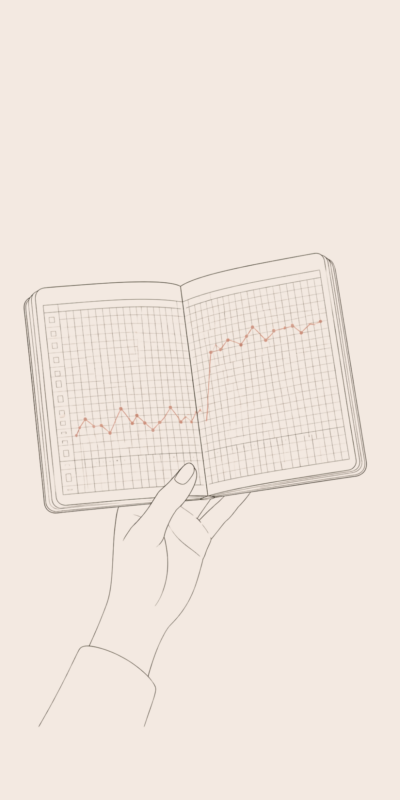
The method consists of three daily steps: measuring your basal body temperature while at rest, observing your cervical mucus throughout the day, and recording both of these signs on a chart. The results are then interpreted according to specific rules by cross-referencing the two signs. The sections above detail each step.
Whenever you like. The easiest way to start is on the first day of your period, which marks the beginning of a new cycle and a new chart. But there’s no reason you can’t start in the middle of a cycle: your first few entries will serve as practice, and the next cycle will start on a clean slate.
There are three possible routes: oral (under the tongue), vaginal, or rectal. The key is to choose one and stick with it throughout the cycle, as the readings differ slightly from one route to another. The measurement should be taken while completely at rest, under conditions that are as consistent as possible.
Basal body temperature is the body’s temperature at complete rest: that is, the temperature taken in the morning upon waking, before getting out of bed and before engaging in any activity. It varies by only a few tenths of a degree throughout the cycle; therefore, you need a thermometer that displays two decimal places. But the tool alone isn’t enough—consistency in measurement conditions is just as important.
That is precisely where the symptothermal method truly shines. It makes no assumptions about the length of your cycle: it reads what’s actually happening, including late ovulation.
Yes, with safety guidelines tailored to this unique period. Our blog has a series of articles dedicated to this topic.
The easiest way is to start by understanding the two main indicators. Our articles guide you step by step: basal body temperature, cervical mucus, and the phases of the cycle. And if you want to follow along on this journey VitaCycles, leave us your email address—you’ll be the first to know.
Be among the first to discover VitaCycles
Sign up to follow the project's progress, get a behind-the-scenes look at its development, and be among the first to hear about its launch.
You'll also receive our content on the menstrual cycle and the symptothermal method.