Cervical Mucus: Understanding and Observing This Sign of the Menstrual Cycle

Cervical Mucus: Understanding and Observing This Sign of the Menstrual Cycle
It’s rarely discussed, and it’s often mistaken for ordinary discharge, yet it’s one of the most telling signs of your cycle. Cervical mucus changes in appearance over the course of several days, and these changes reveal exactly where you are in your cycle. Learning to read it means learning to recognize your fertile window in real time, without calculations or devices.
This guide explains what cervical mucus is, how it changes throughout your cycle, how to observe it day by day, what each characteristic means, and how to avoid confusing it with white discharge.
What is cervical mucus?
Cervical mucus is a secretion produced by the cervix, specifically by small glands located in the cervical canal. It is produced in response to the hormones of the menstrual cycle, particularly estrogen, and its appearance therefore changes in tandem with these hormones.
It serves several functions. It protects the uterus by acting as a barrier against microorganisms. During the fertile window, it facilitates and filters the passage of sperm, allowing only the most motile ones to advance, and it nourishes and shelters them for several days. Outside the fertile window, however, it tightens and forms a tight seal at the entrance to the cervix. It is this dual function—opening and then closing—that makes it such a valuable indicator for tracking the menstrual cycle.
Cervical mucus, white discharge, leucorrhea: What's the difference?
This is the most common source of confusion, and it’s perfectly normal, since the terms get mixed up. White discharge—known in medical terms as leukorrhea—encompasses all normal vaginal secretions: it helps keep the vagina clean and balanced, and is present more or less year-round. Cervical mucus, on the other hand, is only one part of these secretions: it is the mucus that comes from the cervix and changes in appearance throughout the menstrual cycle.
The simple rule to remember: whatever remains more or less constant from one day to the next is considered normal discharge; whatever changes—becoming stringy and slippery at a certain point in the cycle and then disappearing—is cervical mucus. It is precisely this change that you need to pay attention to in order to track your cycle.
Vaginal discharge that turns yellow, green, or clumpy like curdled milk, or that has a foul odor, or is accompanied by itching or a burning sensation, is not part of the normal menstrual cycle: it may indicate an infection and warrants consultation with a healthcare professional.
How Cervical Mucus Changes Throughout the Cycle
From the beginning to the end of the cycle, cervical mucus follows a fairly characteristic pattern, even though each woman has her own variations and the duration of each phase varies from person to person.
After Your Period: The Dry Phase
Immediately after their period, many women experience a phase with no noticeable cervical mucus, accompanied by a sensation of dryness in the vulva. This is a period of low fertility. For women with short cycles, this phase may be very brief or even absent.
Mucus appears: sticky at first, then creamy
As estrogen levels rise, cervical mucus appears: at first, it is sticky or pasty, whitish or slightly yellowish, and present in small amounts. Then it becomes creamy, like lotion, white, and more abundant. The sensation changes from dry to moist. Fertility gradually increases.
As ovulation approaches: fertile cervical mucus
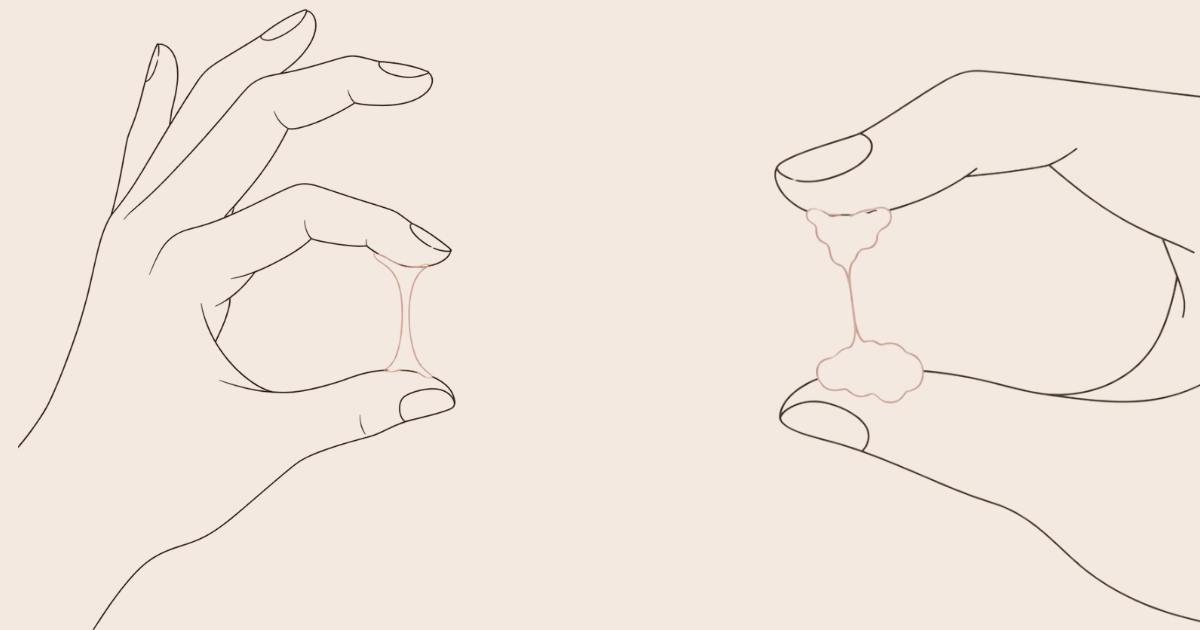
The cervical mucus then undergoes a noticeable change: it becomes clear, slippery, and very elastic, capable of stretching between two fingers. It is often compared to raw egg white. The vulva feels distinctly wet, slippery, and lubricated. This is a sign that the fertile window is fully open.
One thing many people don’t know: the most fertile cervical mucus isn’t always the most visible. For some women, it becomes so thin that it looks like water and is almost invisible, but it leaves a very wet feeling. In this case, the sensation is more important than the appearance.
After Ovulation: Back to Being Dry
Under the influence of progesterone, cervical mucus changes dramatically: it becomes scarcer, thicker, or disappears, and the feeling of dryness usually returns within a day or two. This is a sign that the fertile window is closing.
Later on, due to hormonal fluctuations, you may again notice wet cervical mucus during the second half of the cycle. Thanks to the double-check method, this resurgence does not cause confusion: once ovulation is confirmed by your temperature, the fertile window is closed, and these mucus observations are no longer taken into account for the remainder of the cycle.
Types of mucus: G, L, and S
To describe cervical mucus accurately, we often distinguish between three main types, designated by the letters G, L, and S. These letters aren’t some mysterious code: they correspond to different types of cervical mucus produced at distinct times during the cycle under the influence of hormones. Recognizing them helps you understand where you are in your cycle.
G-mucus (from the German word “Gestagen,” meaning progesterone) is produced under the influence of progesterone outside the fertile window. Thick, opaque, and sticky, it forms a plug at the entrance to the cervix that blocks the passage of sperm and protects the uterus.
L-mucus appears at the beginning of the fertile phase, when estrogen levels rise. With a medium consistency—slightly more fluid—it acts as a filter: it selects the most motile sperm and weeds out the rest.
S-mucus (from the German word *Spinnbarkeit*, meaning “stretchability”) is produced when estrogen levels are at their highest, just before ovulation. Very fluid, clear, and stretchy like egg white, it carries and nourishes the sperm as they travel toward the uterus: this is the most fertile mucus. Upon observation, the L and S types indicate the fertile period, while the G type corresponds to the non-fertile phases.
The mucus peak: the key indicator
When tracking your cycle, the “mucus peak” (sometimes also called the “peak day”) is the last day on which you feel that slippery, fertile sensation or notice that clear, stretchy mucus. It is not the day with the heaviest flow; rather, it is the last fertile day. Therefore, you can only recognize it the next day, when the sensation has changed.
This marker is valuable because it occurs very close to ovulation. The days following the mucus peak remain potentially fertile; that is why, in the symptothermal method, we wait for confirmation from the temperature before considering the fertile window closed.
Mucus: The Early Warning Sign
Here’s what makes cervical mucus such a valuable complement to basal body temperature. As we saw in our article on basal body temperature, temperature confirms ovulation after it has occurred. Cervical mucus, on the other hand, changes before ovulation: its appearance and subsequent transformation into stringy mucus signal that the fertile window is approaching.
In other words, cervical mucus provides an early indication, and body temperature confirms it. This is precisely why the symptothermal method combines these two signs rather than relying on just one: one begins the cycle analysis, and the other concludes it with certainty. This combination is called “double-checking,” and it is the core of the method.
How to Observe Your Cervical Mucus: A Practical Guide
The observation is simple and requires no equipment. Here’s how to do it, step by step.
When and how often
Check several times throughout the day, since cervical mucus changes from hour to hour—for example, each time you use the restroom. At the end of the day, note what you observed as being the most fertile: this is the peak observation that you should record.
What to Look For
Two things, always. First, how your vulva feels throughout the day: dry, damp, wet, slippery. Second, the appearance—if you notice any discharge, for example when wiping: its color, texture, and how well it stretches between two fingers. The sensation matters just as much as the appearance, sometimes even more: that’s the key lesson of discharge observation methods.
How to Grade
Every day, record your most fertile observation—in your own words or using the categories of the method you’re learning. It’s the sequence of days, not a single day, that reveals your pattern. After two or three cycles of observation, you’ll be able to recognize your own pattern.
What to Avoid
Avoid checking immediately after sexual intercourse: semen and the lubrication caused by arousal can mix with the cervical mucus and skew the reading on the same day and sometimes the next day. Keep track of your sexual activity to be aware of this. Similarly, overly vigorous cleansing of the genital area or taking a shower right before checking can interfere with the reading.
Some Techniques for Better Observation
There are several simple ways to recognize cervical mucus. When you use the restroom, first pay attention to how it feels when you wipe (does the toilet paper slide easily? Is the area wet?), and then check what it looks like on the toilet paper. You can also collect a small amount of mucus and test its elasticity by gently pulling it apart between your thumb and index finger: fertile mucus stretches into a string, while non-fertile mucus breaks immediately.
The “glass of water” technique is particularly useful when the observation is unclear—for example, after intercourse—or when you’re unsure whether the discharge is cervical mucus or semen. The principle: place the collected discharge in a glass of water. Fertile cervical mucus, which is rich in water, retains its cohesion and forms a small mass that holds together—sometimes remaining suspended or falling in strands—while semen and ordinary discharge dissolve and disperse in the water. This is a helpful tip, not absolute proof, but it comes in handy on days when you’re unsure.
Finally, if you notice very little cervical mucus—or if it’s still difficult to interpret—another sign can help: observing the cervix, which softens, rises, and slightly opens as ovulation approaches. We’ve written a separate article on this topic; read it to learn how to observe these changes.
What Can Affect Mucus
Several factors can temporarily change the appearance of cervical mucus or make it harder to observe: recent sexual intercourse, an infection or yeast infection, certain medications, stress, a hormonal imbalance, or breastfeeding. A small amount of cervical mucus may also simply be normal for you, especially at the beginning of your cycle. This is nothing to worry about in itself: these are factors to keep in mind when tracking and interpreting your symptoms.
When to Seek Medical Attention
Monitoring your cervical mucus can also alert you to changes in your reproductive health. If your cervical mucus or discharge changes color in an unusual way (bright yellow, green, or gray), becomes foul-smelling or clumpy, or is accompanied by itching, burning, or irritation, you should consult a healthcare professional. The same applies to repeated bleeding outside of your period. Regular monitoring also helps you better identify anything out of the ordinary, and this is one of the often-unexpected benefits of the method.
Mucus: A Symptom to Watch For
Cervical mucus is undoubtedly the most accessible sign for learning to track your cycle: it costs nothing, requires no tools, and provides quick results. But like any sign, it reveals its full value when cross-referenced with another—in this case, basal body temperature.
That’s the whole idea behind symptothermal contraception, an observational method that teaches you how to interpret these signs together. To understand the method as a whole, check out our comprehensive guide to symptothermal contraception. And for the sign that confirms ovulation, read our article on basal body temperature.
Frequently Asked Questions
Cervical mucus appears after the dry phase that follows menstruation, when estrogen levels rise. It becomes increasingly fertile as ovulation approaches, then disappears afterward. In women with short cycles, it may appear very early, sometimes as soon as menstruation ends.
As ovulation approaches, the cervical mucus becomes clear, slippery, and very stretchy: it stretches between two fingers, much like raw egg white. The vulva feels noticeably wet and slippery. For some women, it is so thin that it is invisible, but the slippery sensation remains very noticeable.
White discharge (leucorrhea) refers to all normal vaginal secretions and remains fairly consistent. Cervical mucus is the discharge that comes from the cervix and changes in appearance throughout the cycle: it is this change—from a stringy texture to eventually disappearing—that distinguishes it.
There are several possible reasons: a phase of the cycle when fertility is low, insufficient hydration, stress, certain medications, a hormonal imbalance, or simply how your body typically functions, since the amount of cervical mucus varies greatly from one woman to another. Therefore, minimal cervical mucus isn’t necessarily a sign of a problem. If you notice little cervical mucus, you can rely on another sign to track your cycle: observing your cervix, which softens, rises, and slightly opens as ovulation approaches. And if the absence of fertile cervical mucus persists and concerns you, a healthcare professional can provide guidance.
Cervical mucus alone cannot tell you whether you are pregnant. After ovulation, it usually becomes thicker or disappears, regardless of whether pregnancy has occurred. Only a pregnancy test can provide a definitive answer. Cervical mucus provides clues about your cycle, not a diagnosis.
Yes. The absence of fertile cervical mucus does not necessarily mean that ovulation has not occurred: the mucus may be present but difficult to detect. This is also why the symptothermal method always considers both cervical mucus and body temperature, rather than relying on a single sign.
Yes, but tracking requires specific reference points for this phase, when ovulation resumes gradually and can sometimes be difficult to detect. Our blog has a series of articles dedicated to this topic.
Sources
Frank-Herrmann, P., Heil, J., Gnoth, C., et al. “The effectiveness of a fertility awareness-based method to avoid pregnancy in relation to a couple’s sexual behavior during the fertile period: a prospective longitudinal study.” ” Human Reproduction, 2007, vol. 22, no. 5, pp. 1310–1319. DOI: 10.1093/humrep/dem003.
Billings, J. J. “The validation of the Billings Ovulation Method by laboratory research and field trials.” *Acta Europaea Fertilitatis*, 1991, vol. 22, no. 1, pp. 9–15. Pioneering work on cervical mucus observation and the concept of the peak day.
NFP Working Group. Natural and Safe — The Practical Guide (Sensiplan). Reference Manual for the Symptothermal Method.